
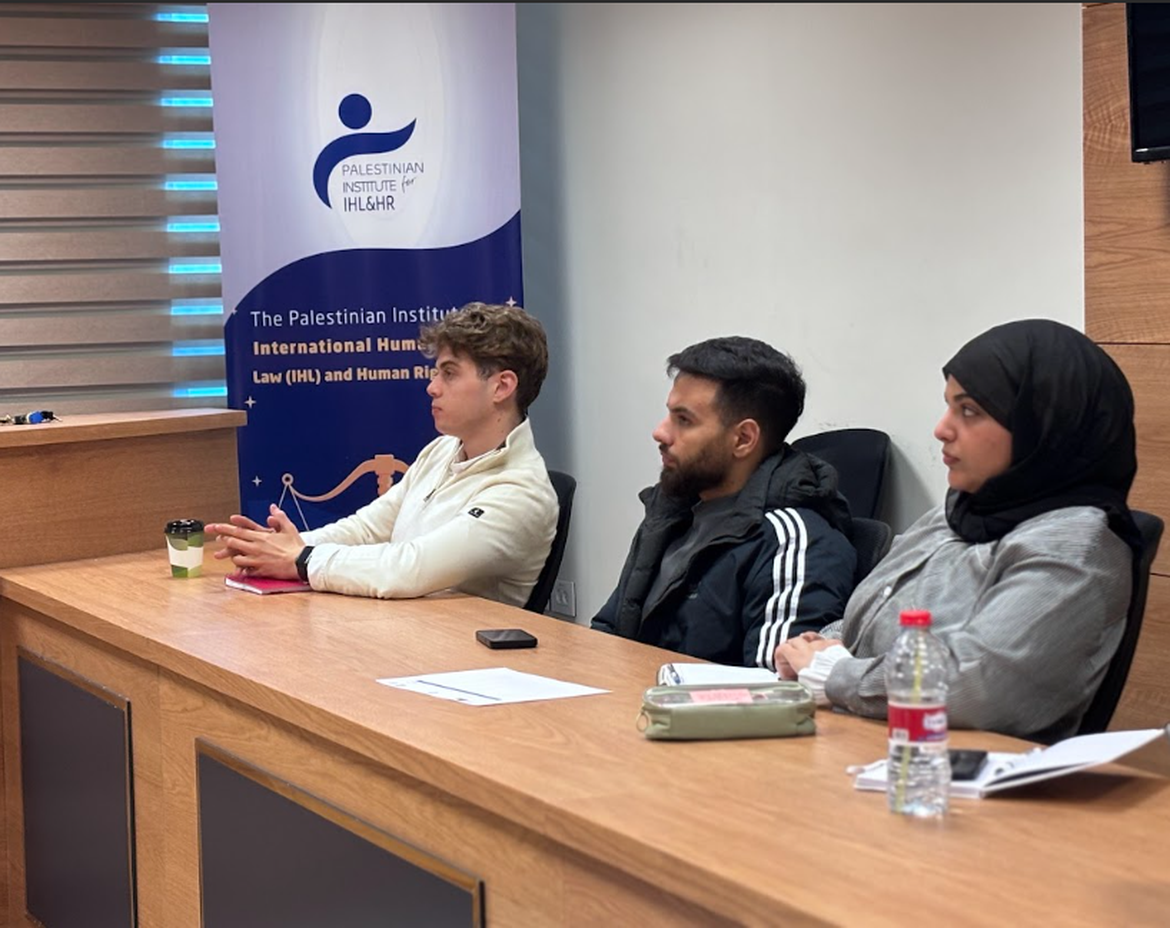
The Palestinian Institute for International Humanitarian Law and Human Rights, in cooperation with the Faculty of Law and Political Science at An-Najah National University, hosted a roundtable discussion on Monday, 1 December 2025. The session brought together Professor Peter Levine—Dean of Academic Affairs at the Jonathan M. Tisch College of Civic Life and Professor of Citizenship and Public Affairs at Tufts University in the United States—with a group of law students specializing in International Relations. The meeting was attended by Dr. Amjad Al-Qunni and Mr. Ihab Al-Sarkaji, representing the Center for Professional and Academic Development at An-Najah National University.
The session opened with welcoming remarks by Ms. Bisan Abtli, Coordinator of the Institute’s Establishment Project, who welcomed the guests and students and emphasized the importance of such activities in enriching the academic environment of the faculty.
Professor Levine delivered an academic presentation addressing the principles of designing successful community groups and social movements, drawing on his research experience, the American experience in community organizing, and the work of prominent American scholar Elinor Ostrom, Nobel Laureate in Economics. Levine explained the theoretical foundations behind the success of civil movements and introduced students to practical models for understanding how groups working toward shared goals develop.
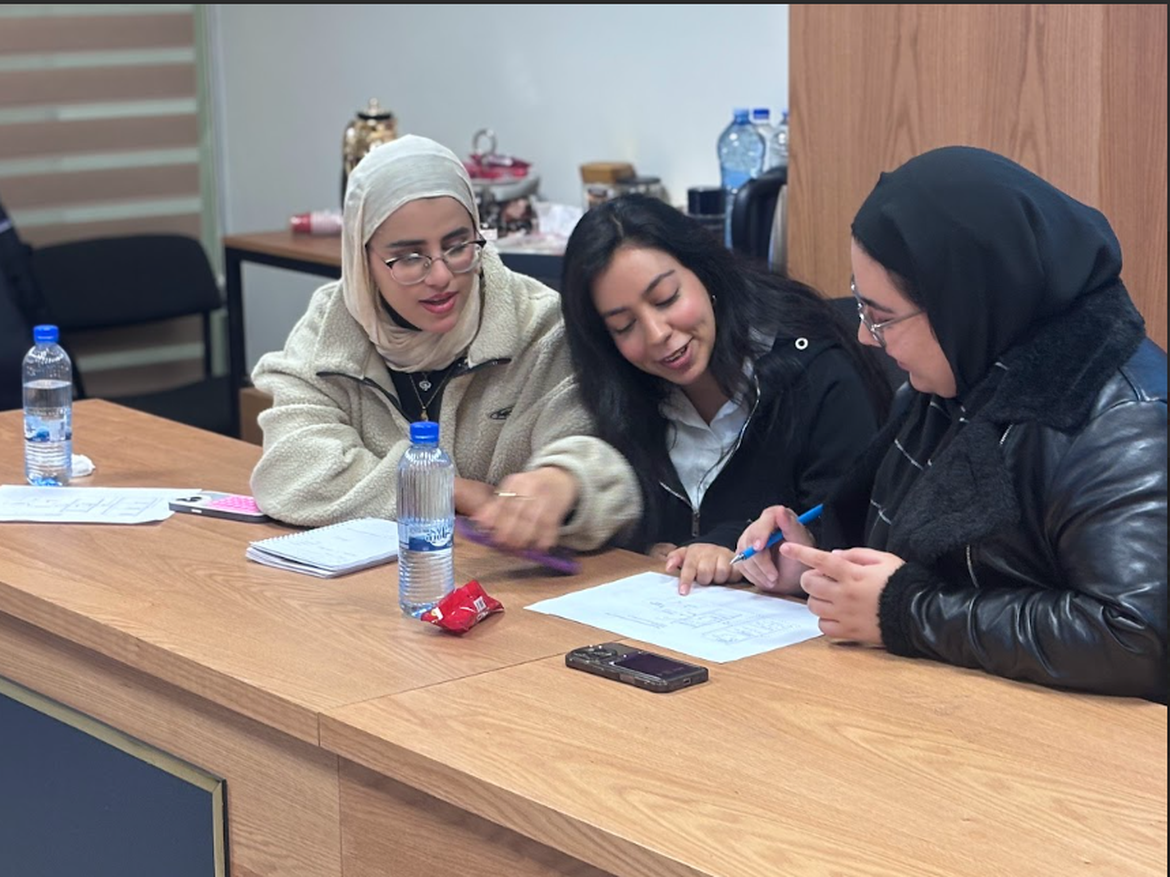
He also provided an in-depth analysis of the central idea of his book “What Should We Do?”, examining each word of the question as an entry point for rethinking collective action, civic initiative, and the role of individuals within social movements. The session included an interactive practical exercise in which students were divided into small groups to select a social movement and analyze it according to the principles presented by Levine, allowing them to link theory with real-world applications.
The session witnessed strong engagement from students, particularly during discussions on the effectiveness of social movements in the Palestinian context, the challenges facing youth initiatives, and how global theories can be adapted to local realities. The discussion was described as broad and fruitful, reflecting students’ interest in methods of civic organization and tools for social impact.
In closing, Dr. Amjad Al-Qunni emphasized the importance of strengthening international academic cooperation in enriching students’ educational experiences. He pointed to the possibility of expanding cooperation between An-Najah National University and Tufts University through additional events and future academic visits for outstanding students, with the aim of supporting their initiatives and developing their skills in the fields of law and civic engagement.
This event comes as part of the Palestinian Institute for International Humanitarian Law and Human Rights’ efforts to enhance international academic partnerships and to provide interactive knowledge spaces that contribute to building an informed generation capable of developing critical perspectives in the fields of law and international relations. The activity falls within the various initiatives implemented by the Institute under the Institute Establishment Project, funded by the European Union.
عدد القراءات: 16