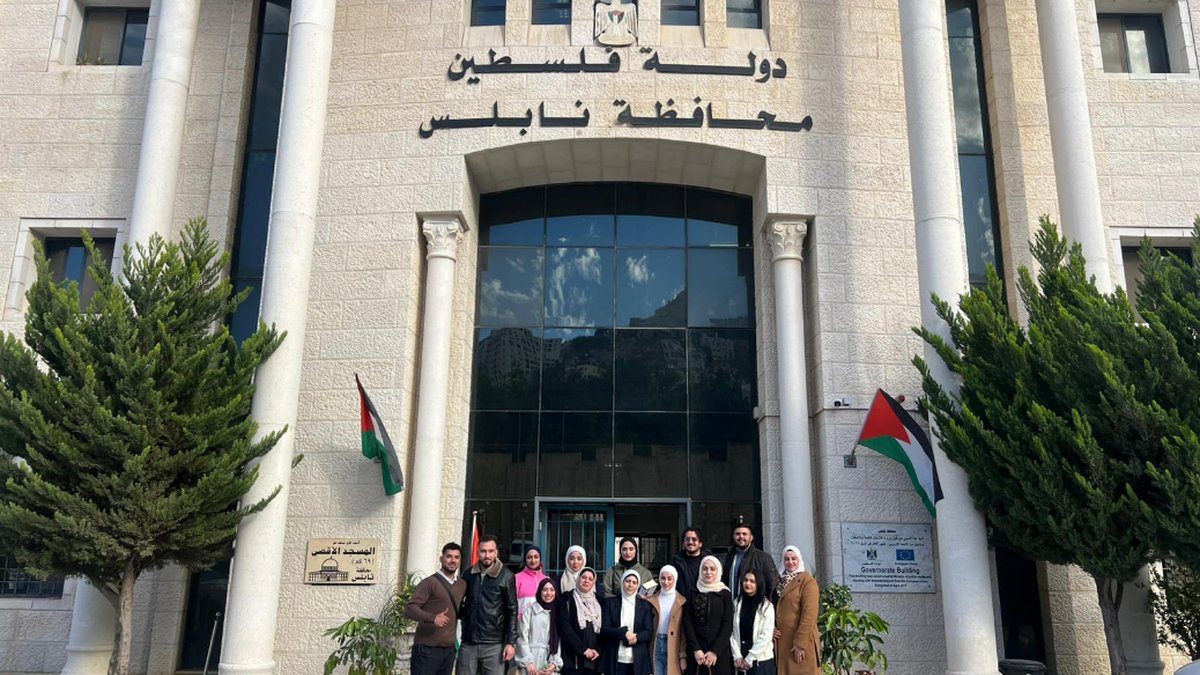
The Legal Clinic organized a field visit for students of the Human Rights and Gender course at the Faculty of Law and Political Science at An-Najah National University to the Gender Unit at the Nablus Governorate. The visit was attended by course students and a team of Legal Clinic volunteers, under the supervision of Ms. Safa Balawi, Director of the Legal Clinic and lecturer of the course. This activity was conducted within the framework of promoting practical legal education and linking theoretical knowledge with real-world practice.
During the visit, Ms. Sajeda Al-Kayed, Director of the Gender Unit at the Governorate, together with Ms. Layali Swalmeh, Officer in charge of Women and Child Affairs at the Governorate, provided a comprehensive overview of the National Referral System in Palestine. They explained its role as a nationally adopted mechanism to ensure the protection of survivors of violence particularly women and children through coordinated efforts between official institutions and civil society organizations, guaranteeing the provision of integrated legal, social, psychological, and health services. The discussion also highlighted the importance of the referral system in enhancing access to justice and protecting rights, in line with national efforts to strengthen the rule of law and social justice.
The speakers further addressed gender-related issues within the Palestinian context, clarifying their legal and social dimensions and the role of official institutions in addressing such issues from a rights-based and humanitarian perspective. They emphasized the importance of raising law students’ awareness of gender concepts, given their direct impact on future professional practice and on engaging with vulnerable groups in a responsible and informed manner.
The visit featured an interactive and in-depth discussion with students, who raised questions regarding the practical application of the National Referral System, the challenges facing the protection of survivors, and the role of lawyers in supporting women’s and children’s rights. This dialogue contributed to strengthening students’ analytical skills and bridging the gap between the theoretical concepts addressed in the academic course and the practical realities of institutions operating within the protection and justice sectors.
This visit reflects the integration of academic courses with the activities of the Legal Clinic, as the Clinic seeks to provide students with applied learning opportunities, enhance their practical understanding of human rights and gender issues, and familiarize them with national protection pathways. Such efforts contribute to preparing students to play an effective professional and humanitarian role in serving the community, particularly vulnerable and marginalized groups.

The activity also aligns with the commitment of the Legal Clinic and An-Najah National University to supporting the Sustainable Development Goals, particularly Goal 4 on quality education, Goal 5 on gender equality, and Goal 16 on justice and the rule of law. The visit contributes to preparing students capable of addressing gender issues with high legal and professional sensitivity, while strengthening their future role in promoting human rights and sustainable development within Palestinian society.
This activity is part of a series of academic and field-based initiatives implemented by the Legal Clinic at the Faculty of Law and Political Science, aimed at linking academic curricula with practical realities, strengthening partnerships with official institutions, and empowering students to play an active role in promoting justice and protecting human rights.
عدد القراءات: 61