

As part of its efforts to advance clinical legal education and keep pace with digital transformations in legal practice, the Legal Clinic at the Faculty of Law and Political Science at An-Najah National University organized a specialized training titled “Legal Applications of Artificial Intelligence”, held from 23 March to 13 April 2026. The training was delivered by Dr. Alaa Al-Deen Dweikat from the Faculty of Business and Communication at the University.
The training targeted students enrolled in the Legal Clinic course and focused on equipping them with practical skills to utilize artificial intelligence tools in legal analysis, legal research, and the drafting of legal memoranda and consultations. Students were introduced to practical applications of generative AI in the legal field and received hands on training on designing legal prompts to generate accurate and reliable outputs that enhance the quality and efficiency of legal work.
The training also addressed the legal and ethical dimensions of using artificial intelligence, including issues related to reliability, professional responsibility, and data protection. It further explored the challenges faced by legal practitioners in light of rapid technological advancements, contributing to preparing students to engage with these developments in a responsible and professional manner.
At the conclusion of the training, Legal Clinic students delivered practical presentations on various legal cases, demonstrating their use of AI tools in analyzing legal facts, structuring legal arguments, and drafting legal documents. These presentations reflected an advanced level of integration between legal knowledge and technical skills, highlighting the positive impact of the training on their academic and professional development.
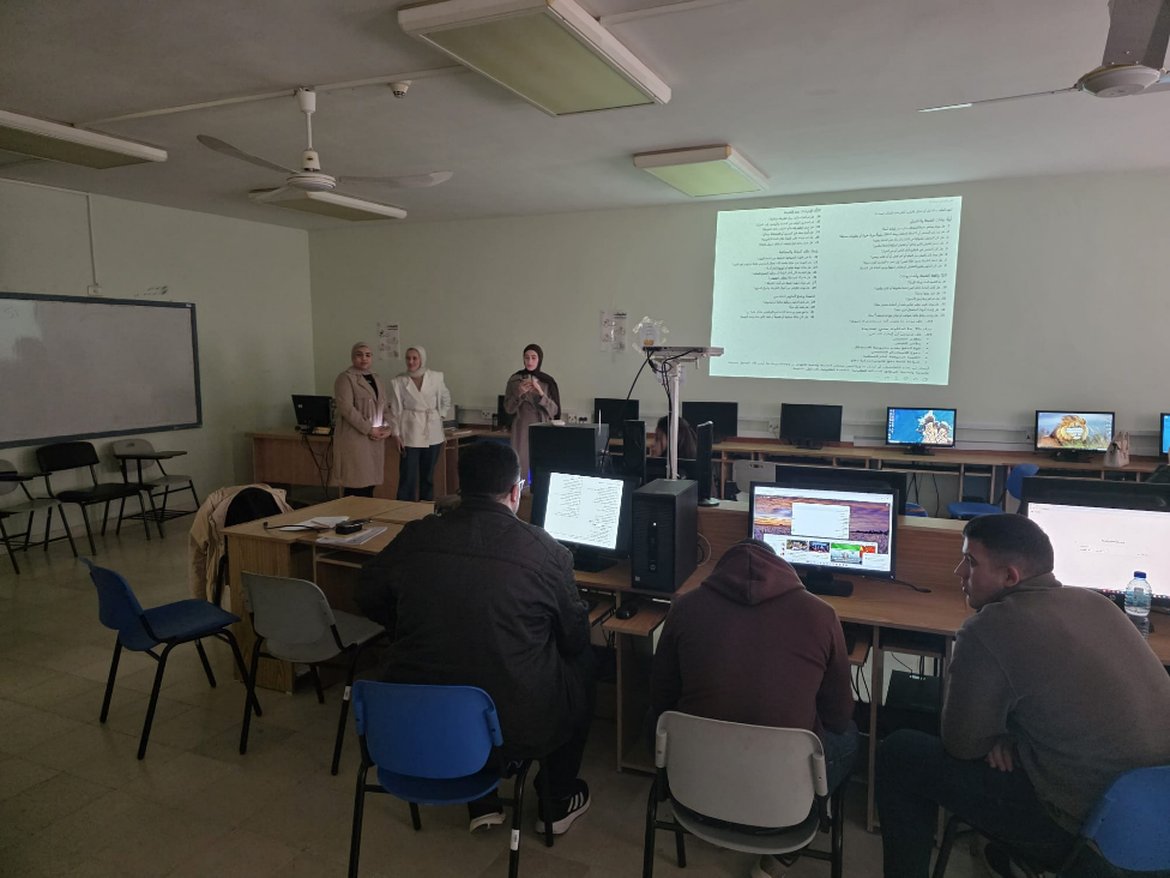
This training aligns with the Legal Clinic’s vision to integrate technology into legal education and to prepare qualified legal professionals capable of meeting labor market demands, enhancing the quality of legal services, and improving access to justice.
Furthermore, the training contributes to the achievement of several Sustainable Development Goals (SDGs), particularly Goal 4 (Quality Education) by enhancing students’ skills and integrating technology into legal education, Goal 9 (Industry, Innovation, and Infrastructure) by promoting innovation and the use of modern technologies in legal practice, and Goal 16 (Peace, Justice, and Strong Institutions) by strengthening legal competencies and supporting the rule of law through the use of advanced tools.
This initiative is part of a broader series of training and awareness activities implemented by the Legal Clinic under the project “Enhancing the Sustainability of the Legal Clinic”, funded by the Sawasya 3 Programme, in partnership with the United Nations Development Programme (UNDP), UN Women, and UNICEF.

عدد القراءات: 72