
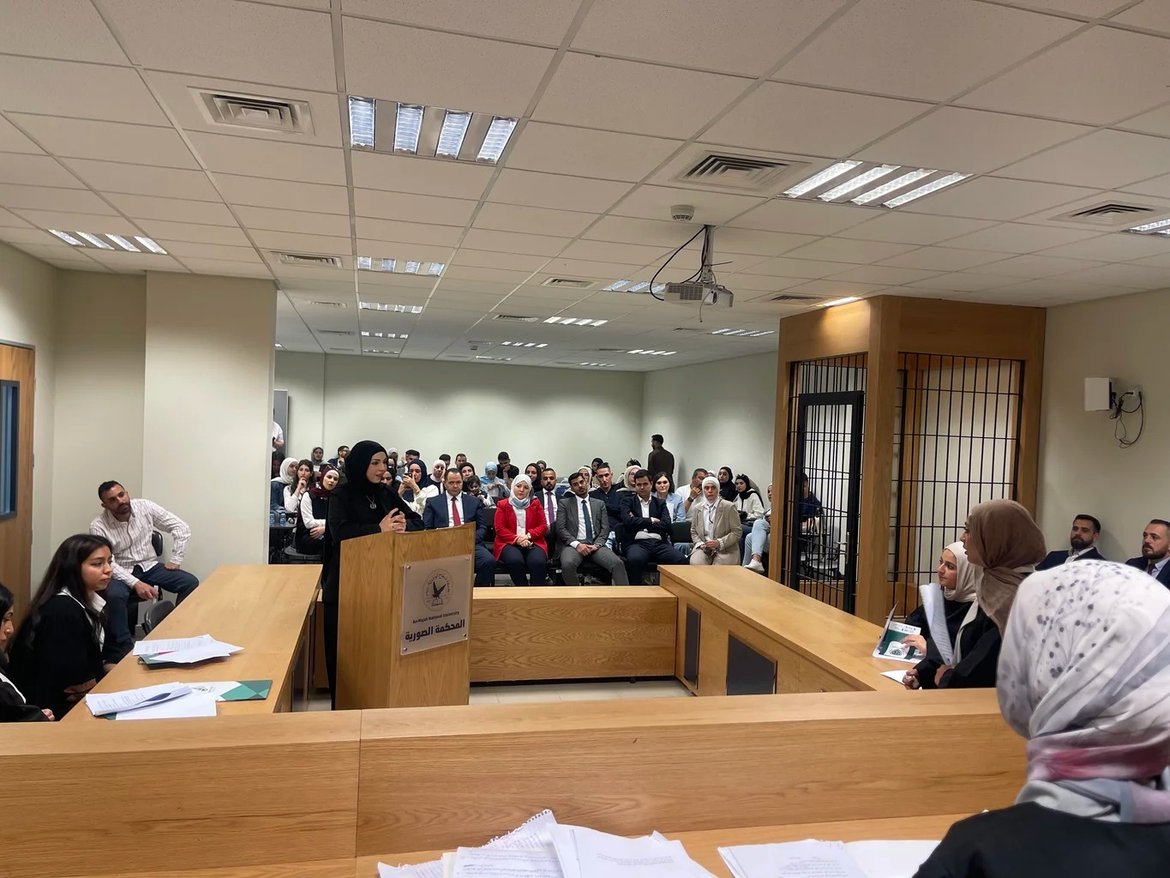
As part of its efforts to enhance clinical legal education and develop the practical skills of law students, the Legal Clinic at the Faculty of Law and Political Science at An-Najah National University organized a Mock Labor Court on Tuesday, 12 May 2026, presented by students of the Faculty of Law and Political Science under the supervision and training of lawyer Rushdi Abu Hamad.
The mock court was held under the title: “A Labor Case: A Legal and Human Rights Reading from the Perspective of Human Rights in the Workplace,” aiming to shed light on the dynamic interaction between labor law and human rights standards within a comprehensive legal and rights-based framework.
The mock court represented an applied educational experience designed to simulate court procedures in labor disputes and enable students to apply theoretical legal knowledge within a realistic judicial environment. Students assumed the roles of judges, lawyers, litigants, and witnesses, demonstrating an advanced level of advocacy, legal analysis, and case management skills.
The simulation addressed legal and human rights dimensions related to workers’ rights, fair working conditions, legal protections for employees, and employers’ obligations under Palestinian legislation and international human rights standards. It also highlighted the importance of integrating human rights principles into legal and judicial practice.
The mock court was preceded by a series of intensive practical training sessions and preparations supervised by lawyer Rashdi Abu Hamad, focusing on legal drafting, advocacy skills, legal presentation, judicial procedures, and legal case analysis, which contributed to strengthening students’ ability to connect academic learning with practical application.
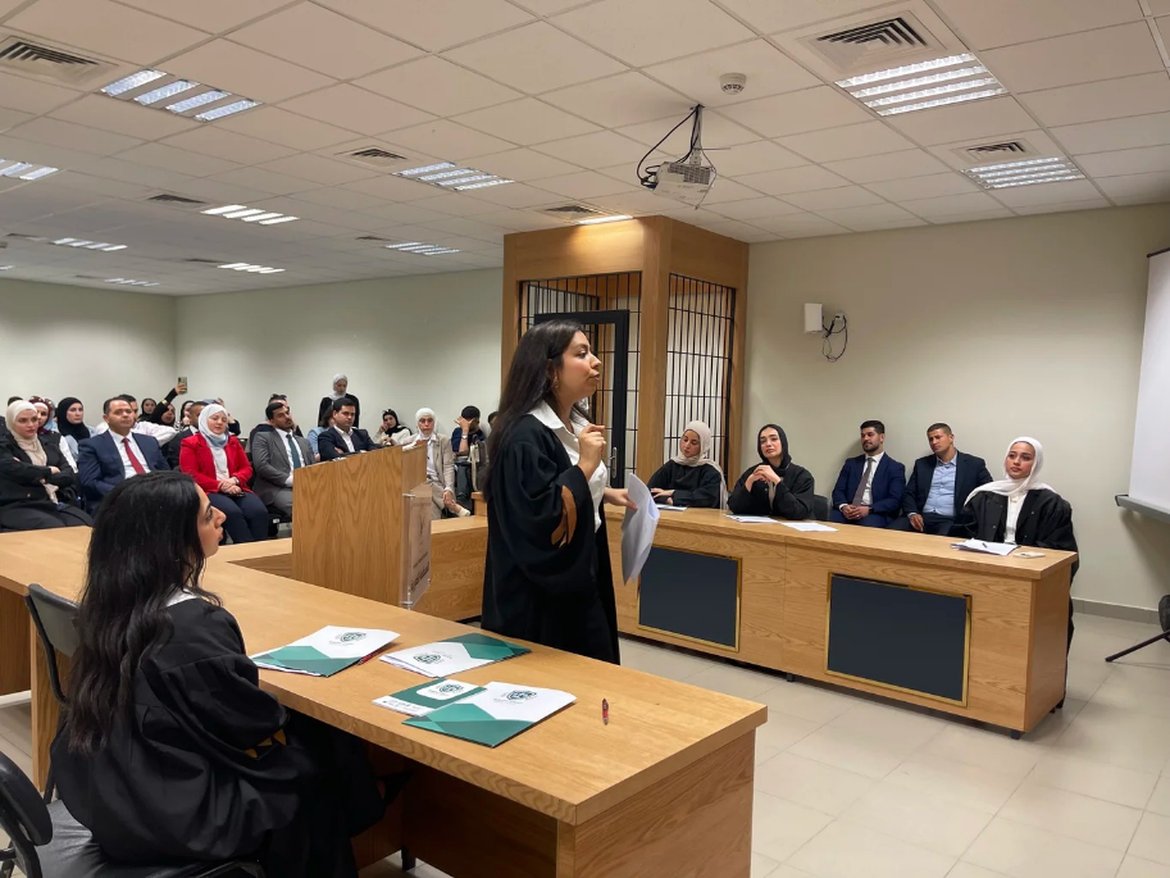
Ms. Safa Balawi, Director of the Legal Clinic, emphasized that the mock court is considered one of the most important tools of practical legal education, as it provides students with a genuine opportunity to develop their professional skills and deepen their understanding of the relationship between labor law, human rights, and access to justice. She also praised the students’ efforts and the practical training that preceded the event.
This activity aligns with the Sustainable Development Goals, particularly Goal 4 on Quality Education through promoting applied and interactive learning, Goal 8 on Decent Work and Economic Growth by raising awareness of labor rights, and Goal 16 on Peace, Justice and Strong Institutions through promoting justice, the rule of law, and strong institutions.
This initiative forms part of the series of activities implemented by the Legal Clinic within the framework of the project “Enhancing the Sustainability of the Legal Clinic,” funded by the Sawasya 3 Programme in partnership with the United Nations Development Programme (UNDP), UN Women, and UNICEF.
عدد القراءات: 53